
AI / ML
Ops Services.

Build · Scale · Transform

Transform ML model development into production-grade systems with intelligent automation, continuous monitoring, and enterprise-scale reliability.
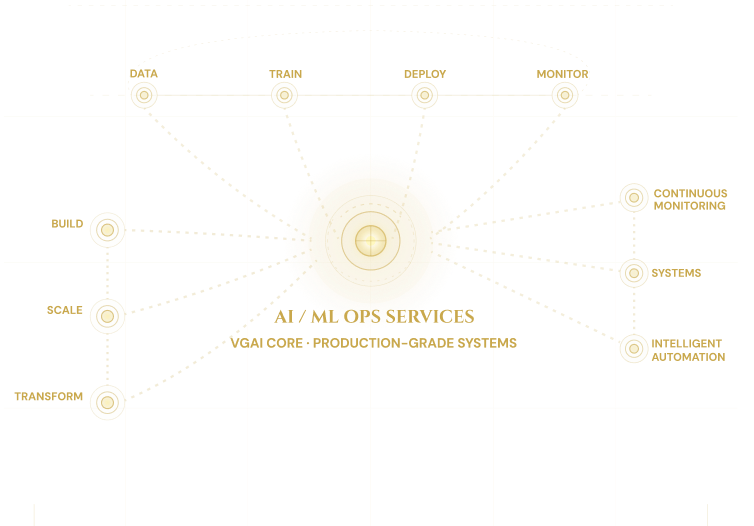
Why AI/ML Ops Matters

From Manual Processes
to Intelligent Operations.

Modern AI systems operate across distributed infrastructure, hybrid clouds, and edge environments. Manual correlation is slow and error-prone. AI/ML Ops brings intelligence to operations.

Icon 1
Data Normalization
Normalize data from disparate sources so it can be analyzed consistently across your entire ML infrastructure and application stack.
Icon 2
Noise Suppression
Suppress alert noise and cluster related events to cut down on fatigue, highlighting probable root causes and blast radius.
Icon 2
Automated Remediation
Recommend or execute remediation automatically where safe, with guardrails and human-in-the-loop oversight for critical decisions.
Icon 2
Predictive Analytics
Predict issues before they impact production using models trained on historical behaviour, enabling proactive maintenance.

Our AI/ML Ops Services

Comprehensive ML Ops Solutions
Across the Full Lifecycle.

End-to-end ML Ops solutions to automate and scale your machine learning lifecycle from development to production and keep it performing long after go-live.

ML Ops Maturity Assessment
Evaluate your current ML operations against industry maturity benchmarks and identify gaps in automation, governance, and scalability.
Current state infrastructure evaluation
Tool stack and workflow analysis
Maturity level scoring (0–5 scale)
Gap analysis and remediation roadmap
Quick-win identification
ML Pipeline Development
Build automated, reproducible pipelines for data ingestion, feature engineering, model training, and deployment.
End-to-end pipeline architecture
Automated data preprocessing workflows
Feature store implementation
Model training orchestration
Experiment tracking integration
Model Deployment & Serving
Deploy ML models to production with containerization, blue-green deployments, and canary releases for zero-downtime updates.
Containerized model packaging (Docker, K8s)
Multi-cloud deployment strategies
Real-time and batch inference endpoints
A/B testing and shadow mode deployment
Model version management
Model Monitoring & Observability
Continuous monitoring of model performance, data drift, prediction quality, and operational metrics in production.
Real-time performance dashboards
Data drift detection and alerting
Prediction quality tracking
Latency and throughput monitoring
Automated model retraining triggers
Model Governance & Compliance
Establish governance frameworks for model lineage, auditability, and regulatory compliance across the ML lifecycle.
Model registry and versioning
Lineage tracking (data, code, artifacts)
Role-based access control (RBAC)
Compliance documentation automation
Bias and fairness monitoring
CI/CD for Machine Learning
Implement continuous integration and deployment pipelines tailored for ML workflows with automated testing and validation.
Automated model testing frameworks
Data validation and schema checks
Model evaluation gates
Automated deployment pipelines
Rollback and recovery automation

Five Stages Of ML Ops Maturity

From Reactive
to Fully Automated.

Organizations progress through predictable stages as they build ML operations capabilities — shifting from reactive firefighting to proactive, closed-loop optimization.

Key Outcomes at Stage 5
MTTR Reduction
60–80% IMPROVEMENT
Deployment Frequency
10× increase
Incident Prevention
Proactive not reactive
Team Efficiency
throughput
1
Reactive
Siloed tools and teams. Data collected mainly after incidents. Constant firefighting with manual processes and ad-hoc model deployment.
2
Integrated
Key data sources feed a central system. ITSM improves. Silos begin breaking down with shared version control and basic automation.
3
Analytical
Coherent analytics strategy emerges. Shared metrics and transparency enable data-driven decisions about model performance and infrastructure.
4
Prescriptive
Automation enters core processes. Machine learning augments human decision-making. Impact measured against business outcomes and SLAs.
5
Autonomous
Closed-loop automation handles routine tasks. Predictive models prevent issues. Stakeholders share data seamlessly. Decisions are proactive and value-driven.

ML Ops Implementation Approach

Pragmatic, Phased
Implementation.

A practical, phased approach that builds capabilities incrementally and delivers measurable ROI at each stage — not a big-bang transformation.

01
Assess & Prioritize
Map current tools, data sources, incident patterns, and bottlenecks. Identify highest-cost pain points and measurable quick wins.
Infrastructure and tool inventory
Workflow and handoff mapping
Pain point identification
Use case prioritization matrix
ROI estimation for top initiatives
02
Build Data Foundation
Ensure reliable ingestion of logs, metrics, traces, and events. Normalize and enrich with ownership, topology, and SLIs/SLOs.
Data pipeline architecture
Metrics and logging standardization
Feature store implementation
Data versioning (DVC, LakeFS)
Quality monitoring frameworks
03
Introduce Safe Automation
Begin with human-approved actions, then move to closed-loop remediation where confidence is high and guardrails exist.
Automated retraining pipelines
Model deployment automation (CI/CD)
Drift-triggered workflows
Approval gates and rollback mechanisms
Incident playbooks and runbooks

Key Benefits of AI/ML Ops

ML Ops Fundamentally Changes
the Economics of AI.

ML Ops compounds value over time every improvement to your operations infrastructure makes the next improvement faster and cheaper.

Lower Operational Costs
Lean teams equipped with ML Ops manage larger, more complex ML estates. Avoid expensive misdiagnoses and reduce cloud waste through intelligent resource optimization.
Faster Issue Resolution
Event correlation and root-cause analysis compress incident timelines from hours to minutes. Reduce MTTR by 60–80% with automated diagnostics.
Fewer Production Disruptions
Predictive analytics mitigate issues before they hit users or revenue. Shift from reactive firefighting to proactive maintenance windows.
Smoother Collaboration
Unified data model reduces manual handoffs and errors. Data scientists, ML engineers, and operations teams work from shared truth, improving throughput.
Better User Experiences
Higher model availability and consistent performance translate directly into stronger customer satisfaction and retention metrics.
Scalable Cloud Management
Consistent visibility and control across public, private, and hybrid environments. Optimise Fin Ops with real-time telemetry and automated scaling.

ML Ops Use Cases & Applications

Real-World Impact Across
Industries & Domains.

Where AI/ML Ops delivers transformational results across engineering, finance, operations, and sustainability.

FinOps
FinOps & Cloud Efficiency
Align spend with performance by rightsizing resources, eliminating waste, and automating scale decisions based on demand patterns.
Idle resource detection and termination
Over-provisioned asset identification
Demand-based autoscaling
Cost-performance optimization
Engineering
CI/CD & Release Quality
Bring production-grade observability and anomaly detection into the pipeline to spot regressions earlier and ship with greater confidence.
Pre-deployment model validation
Automated regression testing
Canary deployments with health checks
Shadow mode performance evaluation
Performance
Application Performance
Dynamically adjust model serving capacity to match real-time load, improving user experienc while controlling infrastructure costs.
Latency and throughput optimization
Dynamic model quantization
Inference cost profiling
Multi-region load balancing
Reliability
Resilience & Reliability
Move from firefighting to prevention with real-time correlation and predictive insight that cuts MTTR and eliminates unplanned downtime.
Anomaly detection and alerting
Predictive maintenance triggers
Automated incident response
Disaster recovery automation
Sustainability
Sustainable Operations
Reduce energy use and carbon impact through smarter workload placement and utilization without compromising service levels or model accuracy.
Carbon-aware scheduling
Energy-efficient model deployment
Green cloud region selection
Sustainability metrics tracking
Platform
Tool Consolidation
Replace fragmented monitoring stacks with a centralized ML Ops platform that improves signal quality and simplifies workflows across teams.
Unified observability dashboard
Single source of truth for metrics
Reduced vendor sprawl
Streamlined team workflows

Ready to Transform?

Ready to Transform
Your ML Operations?

Deploy once. Optimize forever. Build production-grade AI systems with  VGAI’s ML Ops services – our team is ready to start with a free maturity assessment.